Blog Wheel of the year
Samhain: the Celtic night that gave birth to Halloween
What Samhain is, where it comes from, how long it lasts and the energy it brings: the Celtic festival that closes the year, opens the dark half and honours the ancestors.
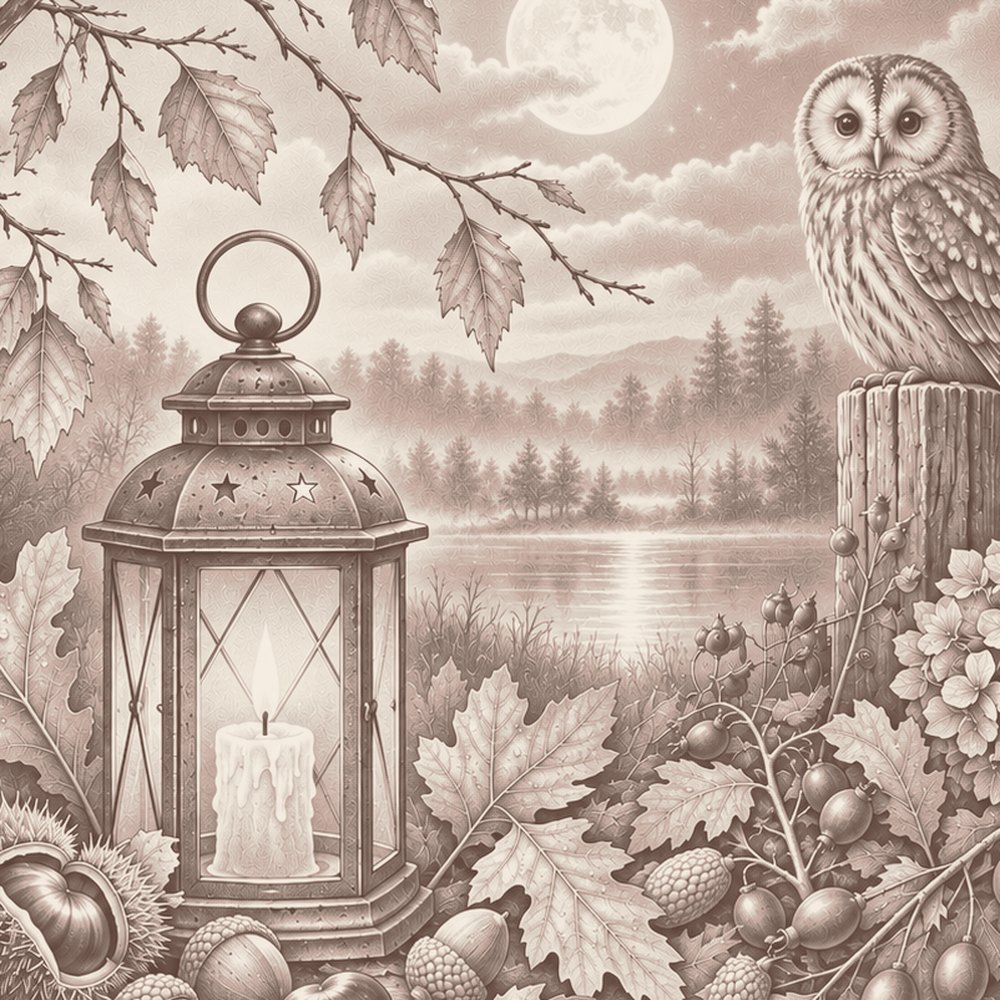
More than two thousand years ago, in Ireland and Scotland, the night of 31 October was the most important of the year. The harvest was over, the cattle came back from the pastures and the dark half of the year began. The Celts called it Samhain (pronounced SOW-in), and for them it wasn't an ending: it was the new year.
What Samhain is
Samhain is one of the four great festivals of the Celtic calendar, together with Imbolc, Beltane and Lughnasadh. It marks the midpoint between the autumn equinox and the winter solstice: the moment when the light truly withdraws.
The Celts believed that on this night the veil between the world of the living and the world of the dead grew very thin. The ancestors could come home: food was left on the table for them and a light in the window. Great bonfires were lit on the hills, too, and each family carried an ember from that shared fire back to its own hearth.
From Samhain to Halloween (and All Saints' Day)
- In the 8th century, the Church set All Saints' Day on 1 November, and the night before became known as All Hallows' Eve: hence Halloween.
- Carved pumpkins come from an Irish custom with turnips: a face to frighten away evil spirits. When the custom reached America, the turnip was swapped for a pumpkin.
- Dressing up is ancient too: it was a way of passing unnoticed among the spirits roaming free that night.
In Spain, the same root lives on in the Galician Samaín, in the roasted chestnuts of All Saints' Day and in visits to the cemetery. In Poland, in the Slavic Dziady and the candles of Wszystkich Świętych (All Saints' Day).
How long it lasts
Like all Celtic festivals, Samhain ran from sunset to sunset: from dusk on 31 October to dusk on 1 November. Today many people keep it for three days, until 2 November, All Souls' Day.
Its energy
Samhain carries the energy of deep autumn: nature lets go of its leaves and withdraws underground to rest. It's a good moment to:
- let go of what you don't want to carry into the new year;
- look inwards: darkness isn't fear, it's rest;
- honour your ancestors: remember where you come from.
A simple ritual for Samhain night
- Place a candle in the window or on the table, for those who are no longer here.
- Write on a sheet of paper what you are leaving behind from this year. If you can, burn it carefully or tear it up.
- Write in your journal a list of what you're grateful for from this cycle.
- Have a seasonal supper: pumpkin, chestnuts, apples, nuts.
- Turn off the lights for a while and sit in silence.
I have it marked on 31 October in my journal: it's my moment of the year to open my goals and see what has grown. If you'd like to discover the other seven festivals, start with the wheel of the year.
Keep reading
The wheel of the year: the 8 seasonal festivals and their dates in 2027
What Imbolc, Ostara, Beltane, Litha, Lammas, Mabon, Samhain and Yule are, when they fall in 2027, and one simple gesture to mark each one.
Read
Lunar calendar 2027: every new moon and full moon (with dates and times)
Dates and times of the 13 new moons and 12 full moons of 2027 in Central European Time, plus the equinoxes and solstices, and how to use each phase.
Read